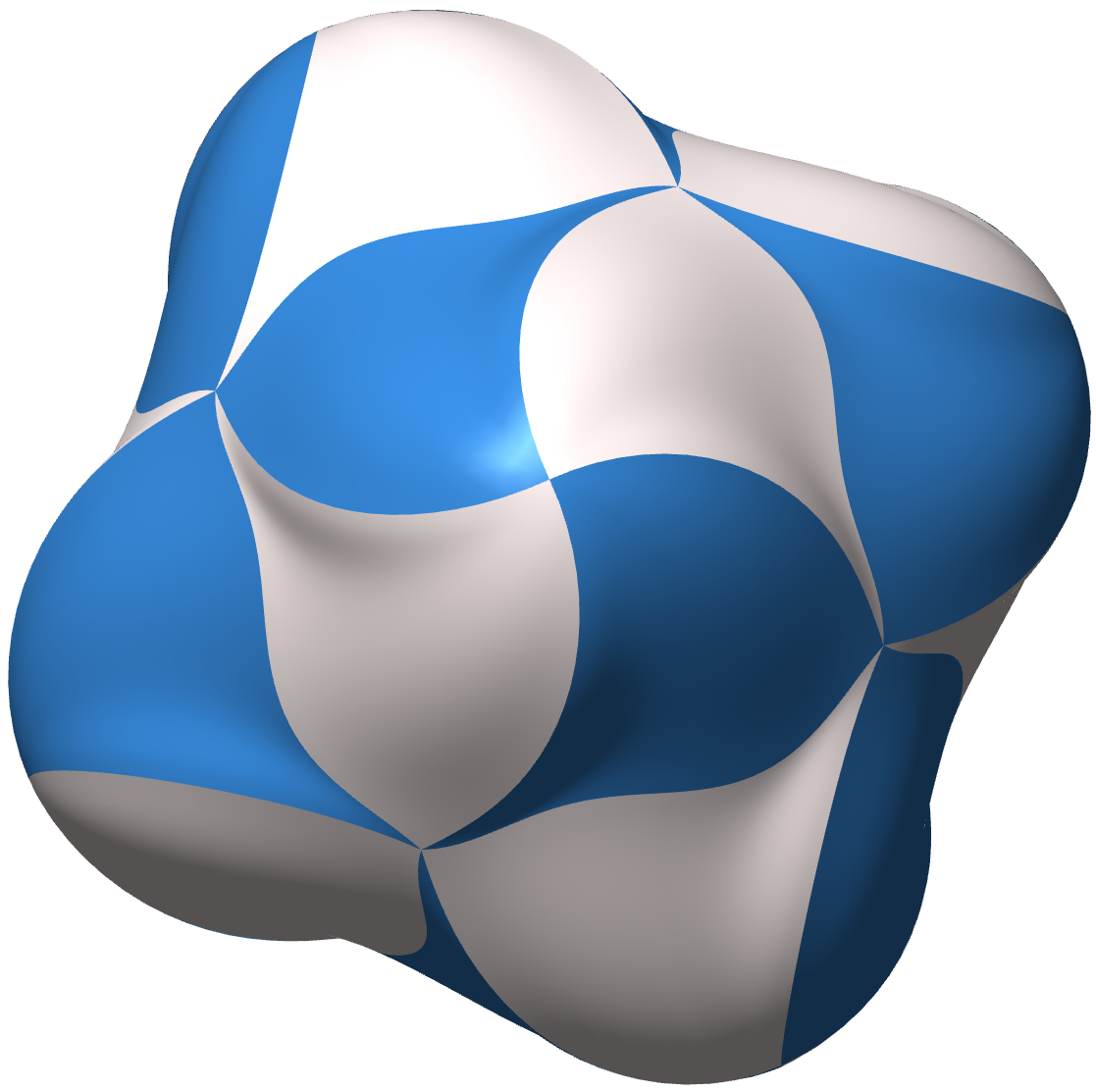
DFF Project: Smooth Tileable Surfaces


This project is funded by the Independent Research Fund Denmark, via a DFF-Rsearch Project 2, grant number 6208-00013B, running February 2027 through July 2030.
We study general smooth surfaces in 3-space that admit tilings by many copies of a single shape (monotileable), or a small number of n proto-shapes (n-tileable). We initiated the study of these surfaces in 2026
here.
Tileable surfaces generalize the classical notion of tiling the plane or the sphere to the case of non-homogeneous surfaces. A practical motivation is the desire to build a physical surface out of many copies of one (or a small number) of identical pieces, to reduce the cost of creating freeform surfaces.
The goal of this project is to develop the mathematical theory of these surfaces, as well as to develop methods for producing many examples of tileable surfaces. Practical applications will also be studied.
Motivating Questions
The building blocks of a tileable surface: For monotileable surfaces, an admissible prototile is the image of a closed toplogical disc embedded in 3-space, regular on the interior, with the special property that the tile can be surrounded by rigid motion copies of itself to form a regular surface. This means that the boundary of the tile must decompose into curve segments that fit together with each other smoothly, and with a well defined surface normal along the join. Here are renderings of two examples of (potential?) admissible prototiles:


Constructing admissible tiles is itself tricky. But even when we have constructed a tile that surrounds itself once, there are still intriguing questions, such as:
Question 1: Given an admissible prototile, can we keep adding layers to obtain a complete surface? If so, what does the surface look like?
Try to imagine the answer to this question for the two tiles displayed above. Scroll to the bottom of this page to see what surfaces are generated.Smoothability of polyhedra: A monohedral polyhedron is a polyhedron the faces of which are all congruent (below, left image). These are analogous to tileable sufaces, if we drop the requirement that the surface be smooth along the edges of the tiles and if we choose the faces to be planar. The edges and vertices of a monohedral polyhedron form an embedded graph in 3-space. Similarly the edges of the tiles in a tileable surface also form an embedded graph (the vertices are where more than two tiles meet).


Question 2: Given a monohedral polyhedron, can it be smoothed? i.e. can we find a smooth tileable surface with the same graph structure?
The example above shows that this is sometimes possible. However we can also find examples where the answer is no: in [1], we show that the triaugmented triangular prism (pictured below) cannot be smoothed: there is no smooth tileable surface with the same graph structure.

Further Reading
Questions 1 and 2 above illustrate the kind of theoretical problems we want to answer in this project, as well as more practical problems such as generation of tileable surfaces and approximation of target shapes by n-tileable surfaces. You can read a more detailed introduction to this topic, as well as some initial results and some open problems in our article [1].
Reference
[1] Brander, David and Gravesen, Jens. "Tileable surfaces" Advances in Geometry, vol. 26, no. 2, 2026, pp. 181-195. https://doi.org/10.1515/advgeom-2026-0004.