
DUDE — Data Uncertainty and Design/Reconstruction Errors
A research project headed by professor Per Christian Hansen, DTU Compute
Funded by Independent Research Foundation
Denmark, from August 1, 2026 to July 31, 2030
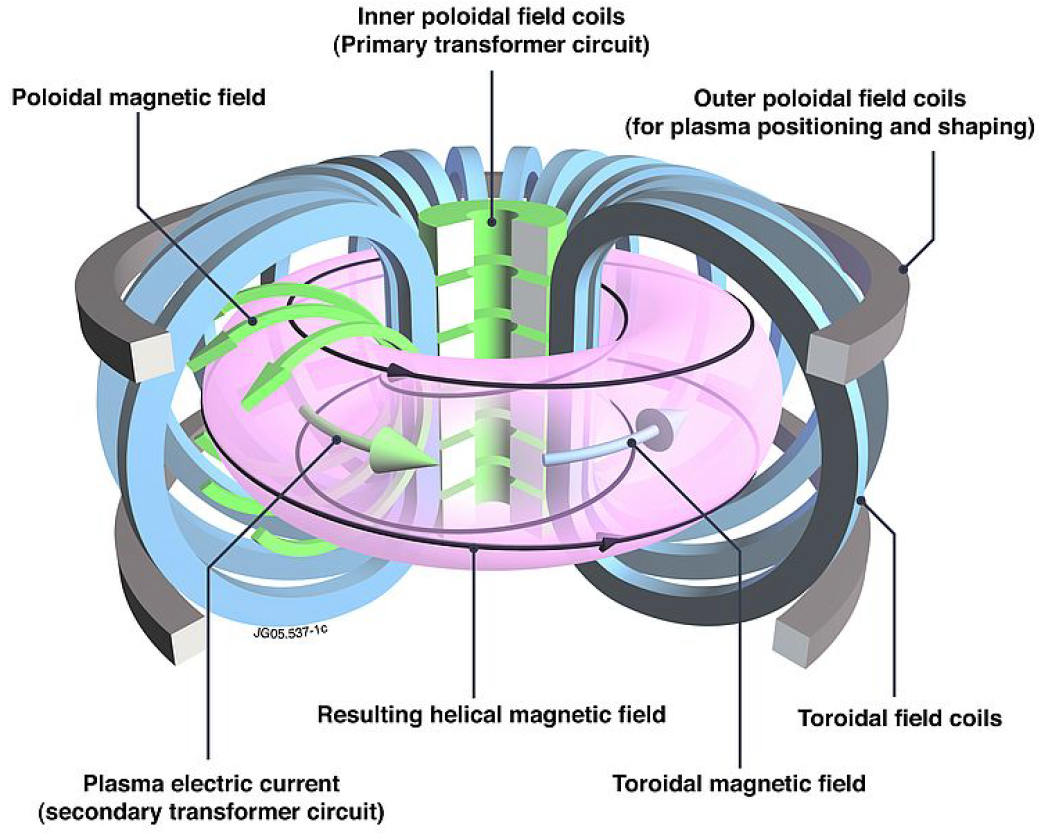
Mathematical design and reconstruction tasks are everywhere, and they often involve inverse problems which are the focus of this project. MR and PET scanners aid brain diagnostics via reconstruction of the blood flow in 3D images with millions of voxels. Datasets of hundreds of images taken inside the mouth are routinely used to compute a digital model of tooth’s surface, which is then used to 3D-print a crown. There many other such tasks, e.g., in antenna design, non-descructive testing, control of tokamak fusion plasma, and astronomical imaging of distant objects.
In all these tasks we use a complex mathematical formulation to compute the desired design parameters and the reconstructed images. Users always need to assess how the computed results are influence by the inevitable errors in the data.
- Are there unwanted artifacts or errors in medical CT or blood-flow images that lead to misdiagnosis?
- Are there errors in the designed shape of the crown that prevents a perfect fit?
- Do we risk instabilities in a tokamak reactor if the reconstruction of the plasma flow is not entirely correct?
We need mathematical tools to help answer these questions, tailored to problems with large datasets where, due to the complexity and computing times, standard “text-book” tools are unsuited.
The team
- Professor Per Christian Hansen
- Postdoc Chao Zhang (funded by the project)
- PhD student Milo Goolkate (funded by the project)
Iterative regularization
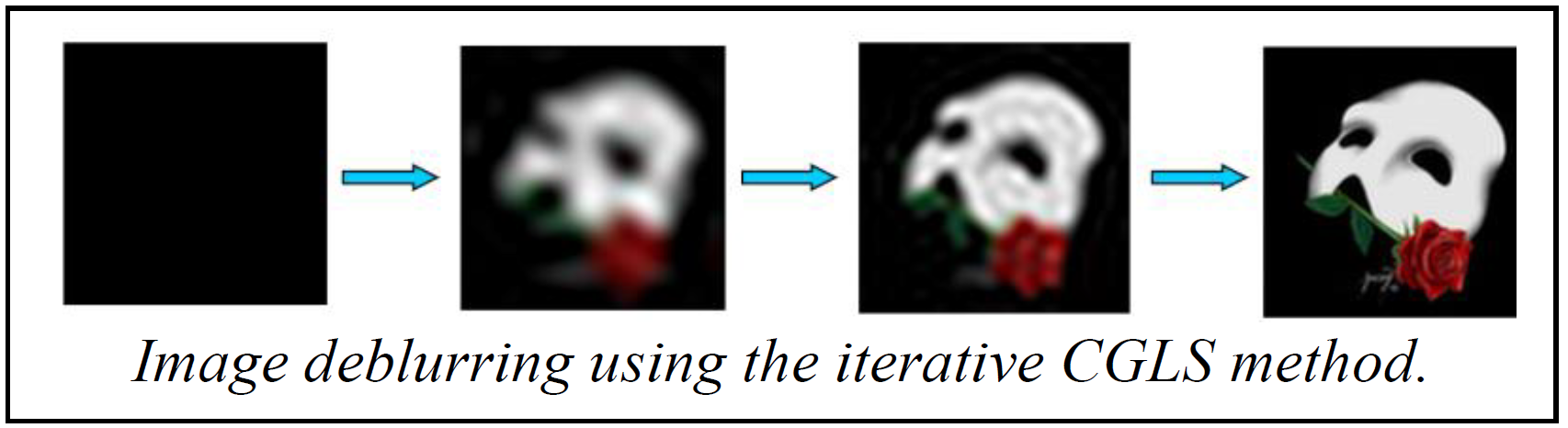
When solving problems with large amounts of data, classical methods are infeasible due to their long computing times and excessive need for storage. Instead, we use iterative reconstruction methods that, from an initial guess, produce a sequence of increasingly better solutions. Kaczmarz’s method is popular in X-ray tomography; CGLS is used in image deblurring.
The study of all these iterative methods requires insight into inverse problems and well as numerical linear algebra (eigenvalues, Ritz polynomials, etc.).
Noise propagation
We need to know how the noise from the data propagates through the iterations in CGLS, GMRES, and other Krylov subspace methods. A basis for such studies is given in this paper which sets the stage for the present project:
- P. C. Hansen, Insight into semi-convergence of iterative regularization methods, Lin. Alg. Appl. (2025), doi 10.1016/j.laa.2025.07.036 (open access).
- P. C. Hansen and M. E. Hochstenbach, On spectral proterties and fast initical convergence of the Kaczmarz method, BIT Numerical Mathematic, 66 (2026), paper 8, doi 10.1007/s10543-025-01098-1.
- P. C. Hansen, K. Hayami, and K. Morikuni, GMRES methods for tomographic reconstruction with an unmatched back projector, J. Comp. Appl. Math., 413 (2022), 114352, doi 10.1016/j.cam.2022.114352 (open access).
Goals and problem formulation
The goal is to give users of design and reconstruction problems a tool to quantify the uncertainties in the computed results, in cases where large data sets must be handled by iterative methods. The project involves these ingredients:- Development of theoretical results, e.g., for the statistics of the growth of the noise error during the iterations.
- Develop a formalism for expressing the regularizing properties of CGLS and other Krylov subspace in a Bayesian setting.
- Developent of computational methods and software that can efficiently provide rigorous characterization of the propagation of errors in large-scale design and reconstruction problems.
- Ensuring that the new methods work for a range of design and reconstruction problems with the same underlying mathematical structure (inverse problems) as well as the need for computer methods suited for problems with large datasets (iterative methods).
Collaborations
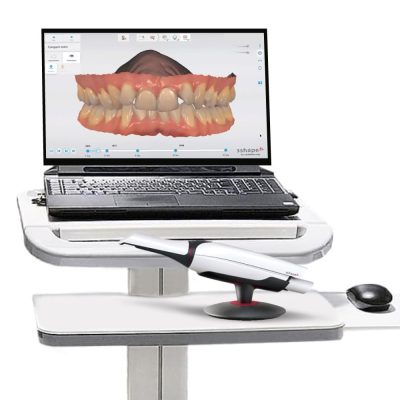

- Uncertainty propagation for 3D oral models in dental treatment, joint with 3shape A/S (left picture above, curtesy of 3shape A/S).
- Uncertainty quantification for phase-space tomography in tokamak fusion plasma, joint work with prof. Mirko Salewski, DTU Physics and assoc. prof. Yiqiu Dong, DTU Compute, (middle picture above, from Wikipedia).
- Statistics of error propagation in iterative regularization methods, joint work with assoc. prof. Michiel E. Hochsenbach, Eindhoven University of Technology (right picture above, from a special issue of Lin. Alg. Appl.).